AI Workflow, Not AI Theatre: A Real Project
Why AI projects fail and how a structured AI workflow creates business value: a real client project with practical guardrails.
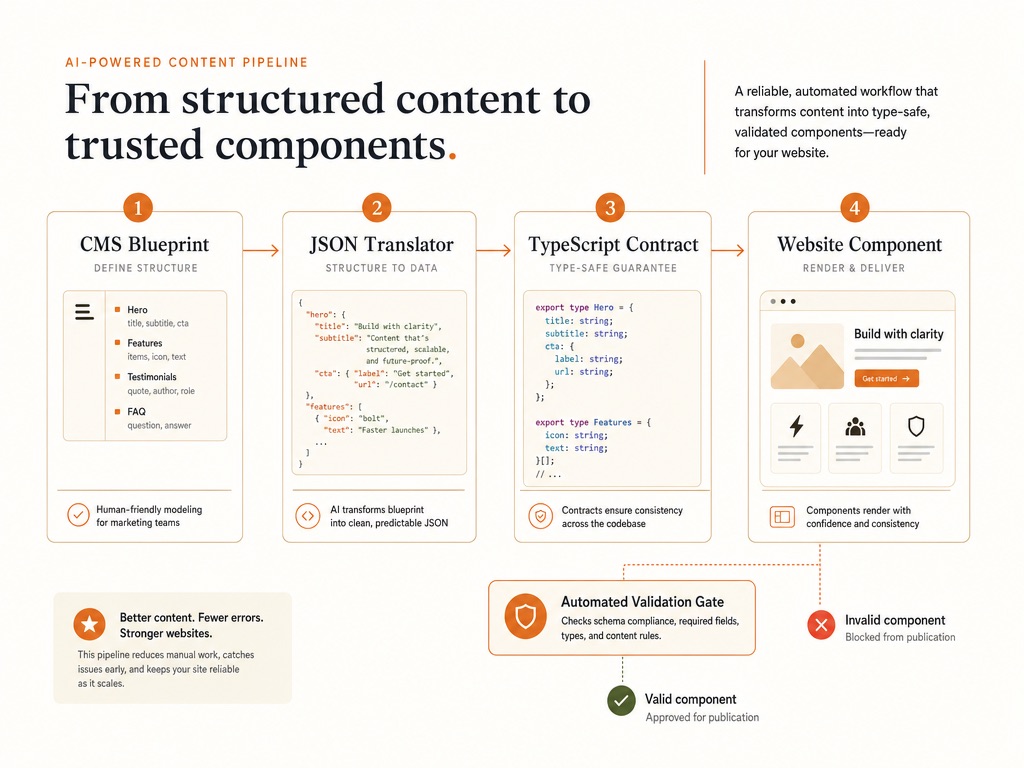
Almost every company is experimenting with AI. Yet after the first impressive demo, many pilot projects leave little behind that can be measured in revenue, cost, or time.
The model is not always the problem. What is often missing is an AI workflow that makes results repeatable and errors visible. A real client project explains what that means better than another prediction about the future of work.
The Numbers Making Business Leaders Nervous
The best-known figure claims that 95 percent of generative AI pilots produce no measurable business value. It comes from Project NANDA's “The GenAI Divide: State of AI in Business 2025” report, published through the MIT Media Lab.
The report draws on 52 structured interviews, responses from 153 senior leaders, and more than 300 publicly documented AI initiatives. That sounds robust. The widely quoted 95 percent figure is not.
The report was not peer-reviewed, and calling it an “MIT study” overstates its status. More importantly, the published data does not clearly show how the 95 percent was calculated. Wharton professor Kevin Werbach read the report several times and called for the underlying data to be released or the claim to be withdrawn. A detailed critique by Futuriom also points to a conflict of interest: the report recommends agentic systems, the same kind of architecture Project NANDA itself is developing.
The headline number does not survive careful scrutiny. The observation behind it should still concern decision-makers.
Germany's 2026 Bitkom AI report offers a firmer reference point. In a telephone survey of 604 companies, 41 percent said they were actively using AI, up from 17 percent in 2024. At the same time, 33 percent said AI had cost more than expected, while 53 percent named insufficient AI expertise in their teams as the biggest obstacle.
Adoption has more than doubled. Skills and processes have not kept pace.
Productivity cannot be judged by instinct either. A 2025 METR study produced a surprising result: experienced open-source developers using the AI tools available at the time worked 19 percent more slowly, while believing they had become 20 percent faster.
Using that result today to argue that “AI slows developers down” leaves out an important update. In February 2026, METR described its follow-up experiment as unreliable because of strong selection effects. Developers who benefited most from AI did not want to work without it, even when paid. Many also withheld the tasks for which they most wanted AI support. METR now believes AI was probably speeding developers up by early 2026, but the size of that effect remains uncertain.
What survives both studies is the gap between perceived and measured value. Nobody knows intuitively whether an AI pilot is productive. And a chat tool does not become a business process just because its first response looks good.
AI Experiment and AI Workflow, Side by Side
Consider a manageable task: a company website needs a calculator that lets prospects estimate their savings potential.
| AI experiment | AI workflow |
|---|---|
| A chat produces finished HTML. | The calculator becomes a component of the existing system. |
| The result looks good after ten minutes. | Content, logic, and presentation follow explicit contracts. |
| Price changes become developer tickets. | The client updates the figures directly in the CMS. |
| Errors surface when someone happens to notice them. | Errors stop the build before publication. |
Both approaches can look similar on launch day. The difference appears with the first price change, the second use of the calculator, or an extension six months later.
An experiment delivers a result. A workflow delivers a result the client can change without me.
The Project: Conlivo
Conlivo develops software for property management companies. It enables them to produce their own heating cost statements instead of outsourcing the entire process to a service provider.
The company needed a new website with a newsroom for articles, press releases, and events, along with search, pagination, structured data, consent and tracking setup, redirects, and a sitemap. Kirby CMS runs the backend and Nuxt the frontend. I describe how this headless setup works in a separate article.
The verifiable project scope:
- two repositories for the backend and frontend
- 115 commits between 2 June and 11 July 2026
- 39 days of project time, just under six weeks
- 86 Vue components
- 20 editable content blocks in the CMS
These numbers do not prove quality. They show the scale at which the AI workflow had to remain reliable. With three components, you can rely on close attention. With 86, a better system helps.
The Potenzialrechner Makes the Difference Visible
The clearest example is the Potenzialrechner, Conlivo's savings potential calculator. It answers a commercial question before a prospect books an introductory call: what does staying with the current solution cost a property management company?
The calculator needs three values:
- number of residential units
- current service-provider price per unit
- new software cost per unit
The formula is deliberately simple: units × (price − cost). The result shows the potential additional annual profit. A disclaimer explains which assumptions the calculation simplifies.
This makes the calculator a sales tool, not decoration. Technically, however, it is not an isolated piece of code. It runs through a chain:
- The CMS blueprint:
potenzialrechner.ymldefines what Conlivo can edit, including labels, units, minimums, maximums, steps, decimals, default values, the disclaimer, and the button destination. - The translator:
blocks-resolver.phpturns the CMS data into clean JSON for the frontend. - The contract:
post.tsdefines in TypeScript what that data must look like. - The presentation: three Vue components display the calculator in an article, in the homepage hero, and share its underlying logic.
All 14 content blocks supported by the frontend are combined in one shared type contract. If someone introduces a new block but forgets one stage of the chain, a broken calculator does not quietly reach the live website. The build reports an error first.
That is the essential guardrail. I do not have to trust AI never to forget anything. I have to make sure forgetting becomes visible.
One detail shows how much good project structure can do. The CMS blueprint contains help text explaining that exactly three input fields are required in a fixed order and how the result is calculated. It helps Conlivo's team use the Panel correctly. The AI reads the same text when working on the project.
One line of documentation therefore serves two readers: the person in the CMS and the model in the codebase. Documentation is no longer a box to tick. It creates delivery speed.
What AI Did, and What It Did Not Do
Recurring implementation was well suited to delegation. Once the blueprint and data contract were settled, AI could carry the pattern reliably across several files. The same applied to similar content blocks, type definitions, translations, and Article, FAQ, and Event schema for search engines.
With 20 content blocks, the first is design and systems thinking. The twelfth is mostly repetition. That is where productivity gains become real.
The decisions that determined the project's value could not be delegated:
- The calculator had to become a reusable CMS block, not a hard-coded piece of a single page.
- The formula needed to remain understandable and required an editable disclaimer because of its simplifications.
- Its presentation on an orange background went through several iterations between 7 and 9 July to resolve contrast, readability, and line wrapping.
- The button following the result needed to lead to an introductory call rather than leave the user alone with an interesting number.
The design iterations were not AI failures. They were the part that required judgement.
I use AI to remove the repetitive parts of my work, not the thinking. The project took just under six weeks not merely because a model can type faster. The advantage comes from being able to think through the next decision while the recurring implementation chain is completed.
I explore this shift from implementation toward judgement in more detail in How AI Is Reshaping Developers' Work.
What the Client Gets from the Workflow
Technical architecture only matters if it improves day-to-day operations. At Conlivo, it does:
- When a per-unit price changes, the team updates the assumption directly in the Kirby Panel.
- The same calculator can appear on the homepage and in an expert article without being built twice.
- The disclaimer remains editable.
- The result leads directly to the next action: booking an introductory call.
- Incomplete technical changes are caught before launch.
That does not mean the calculator's sales impact has already been measured. Real usage and conversion data would be needed for that claim. What can be said is that the feature is designed around a conversion and can be evaluated later.
The most important difference is not visible on launch day anyway. It appears when an assumption changes six months later. One approach means “call the developer.” The other means “open the Panel.”
Those decisions also affect budgets. My guide to business website costs in 2026 explains why AI reduces mechanical work without making architecture, review, and responsibility disappear.
Four Questions for Your Own AI Project
Whether the project involves web development, internal knowledge work, or customer service, four questions quickly separate an impressive AI pilot from a dependable workflow.
- Are errors detected automatically? If the only control is that someone will hopefully notice, you do not have a reliable process.
- Can AI read the context your team uses? Knowledge locked in people's heads and meetings is invisible to a model. Clear files, rules, and data structures close that gap.
- What happens on the twelfth run? A one-off result can be a good demo. A process must remain consistent when repeated.
- Does something useful remain without the AI? With the Potenzialrechner, the result is a CMS component Conlivo can operate independently. Its value is not tied to the next chat session.
For business leaders, that leads to a better question for any AI initiative. Not “Which model are we using?” but “Which existing process becomes reliably better, and how will we know?”
Conclusion
The frequently quoted report does not prove that 95 percent of AI projects fail. It is still plausible that many pilots produce no business value. In most cases, the missing ingredient is not a better model. It is the structure around it.
Contracts, blueprints, and automated checks sound less exciting than an AI demo. They are what turns a fast result into a system that still works weeks and months later.
If your AI project started impressively and has since stalled, do not look at the next tool first. Look at the workflow in which the tool is supposed to operate.
Send me a short note about where your pilot is stuck. A brief conversation is often enough to see whether the problem lies with the tool or the workflow around it.
mail@eugen.workThis article was drafted and translated with AI assistance.