Business Website Cost 2026: €4,500–35,000
€4,500 to €35,000: what a professional business website actually costs in 2026, broken down by scope, plus ongoing costs and how to compare quotes.
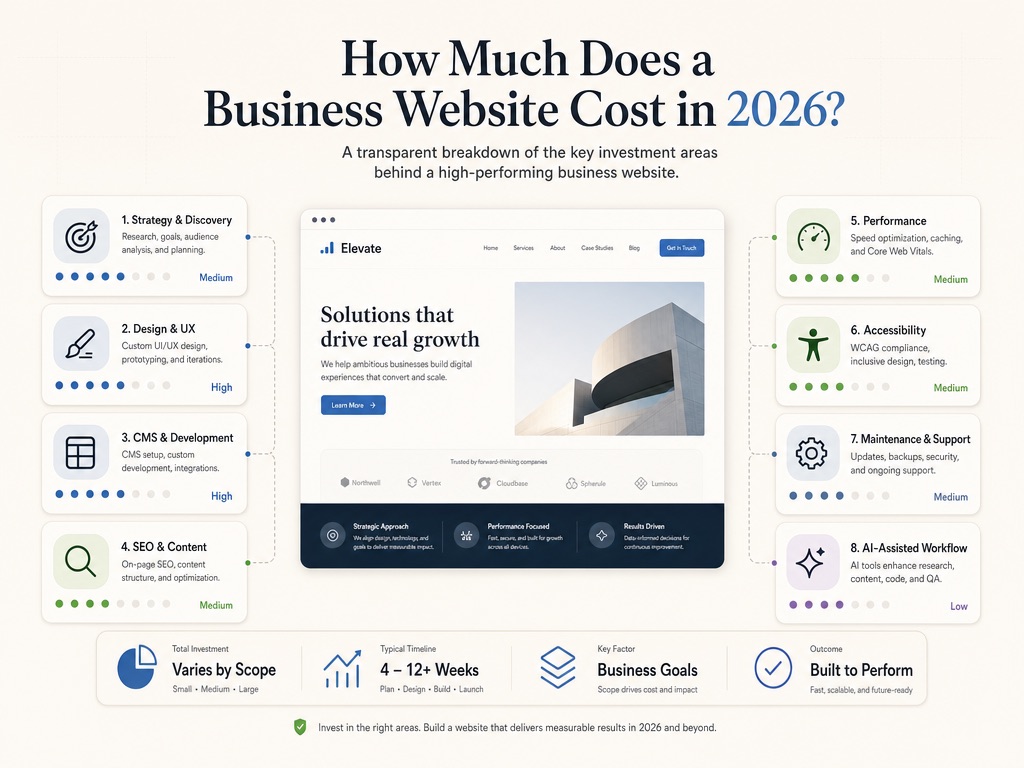
A professional business website in 2026 usually does not cost 999 euros. For a solid project for a small or mid-sized business, the realistic range is closer to 4,500 to 15,000 euros.
That is the short answer.
The better answer is: the price is not only about the number of pages. It depends on what the website needs to do. Digital business card? Sales tool? Recruiting channel? Multilingual platform with CMS, SEO, tracking, and ongoing development? Those are very different projects, even if every offer calls them "a website."
This article should help you compare offers more clearly. Not so you end up buying the most expensive website, but so you can understand which budget fits which level of ambition and where a cheap offer can become expensive later.
Why Website Prices Vary So Much
Website prices often feel random because different providers sell completely different services under the same word.
A one-page template setup is a website. A custom-designed business website with CMS, clean content structure, SEO basics, performance work, privacy setup, tracking, accessibility, and handover is also a website. The difference is not in the word. It is in the scope.
Most price differences come from four areas.
First: scope. How many pages are needed? Are there multiple languages? Do you need a blog, references, case studies, jobs, landing pages, or different content types? A website with five static pages is a different project from a website with 30 pages, multiple target groups, and a CMS your team can maintain later.
Second: implementation quality. Adjusting a ready-made theme is faster than translating a custom design into clean components. A website builder is faster to configure than a custom frontend with a thoughtful CMS. Both can be valid. The offer just needs to make clear what you actually get.
Third: project work around the design. Strategy, page structure, UX, copywriting, SEO, testing, launch support, and training disappear from some offers entirely. That makes the offer look cheaper, but the work is not gone. It either lands on your desk or shows up as a problem later.
Fourth: risk. A solo freelancer, a small specialist team, and a larger agency have different cost structures. A bigger team often means more coordination and higher day rates, but for complex projects it can also reduce risk. Cheaper is not automatically worse, and more expensive is not automatically better. What matters is whether the provider understands the project realistically.
What AI Changes About Pricing
AI is changing web development in a real way. Just not as simply as some LinkedIn posts make it sound.
Yes, AI makes certain parts faster. Initial structure ideas, copy variations, wireframes, components, standard features, SEO drafts, and tests can be produced faster than a few years ago. Simple landing pages can also be created quickly with AI website builders or no-code tools.
That mainly lowers the cost of mechanical work. Things that used to involve a lot of manual typing, copying, and variation building can now be created in less time.
But the bottleneck in a good business website is rarely just typing code. The bottleneck is the decision-making: Which structure fits the company? Which content does the customer really need? What is understandable for Google? What can be maintained later? Which technical setup will still make sense in three years? Which AI output is actually useful and which one only sounds confident?
AI makes simple websites cheaper. It does not automatically make good websites cheap. The value shifts from pure implementation toward briefing, taste, architecture, review, and responsibility.
In my projects, I use AI for exactly that: to reduce implementation time and make more iteration possible within the same budget. The important part is still selection. AI can produce ten variants. Someone has to know which one is good and which one is just pretending.
I wrote more about this shift in How AI Changes the Work of Developers.
Typical Website Budgets in 2026
The following ranges are not laws of nature. They are realistic orientation points for Germany in 2026.
| Website Type | Typical Budget | Best For |
|---|---|---|
| One-pager or landing page | 800 – 3,500 € | Campaigns, early validation, one clear offer |
| Small business website | 2,500 – 6,000 € | ~5–10 pages, local or specialized offers |
| Solid SME website | 4,500 – 15,000 € | Custom design, CMS, SEO basics; the most common case |
| Advanced mid-market website | 15,000 – 35,000 € | Multiple languages, blog, case studies, recruiting |
| Corporate site, portal, or web app | From ~20,000 € | Logins, integrations, custom data logic |
One-Pager or Landing Page: Around 800 to 3,500 Euros
A one-pager makes sense if you have a clear offer and only need a small amount of content: problem, solution, proof, contact. For campaigns, early validation, or very small local offers, that can be enough.
Affordable one-pagers are often based on templates or website builders. That is fine as long as you do not expect a large growth strategy from them. If a blog, SEO landing pages, multiple languages, or more complex content are added later, this setup can hit limits quickly.
Small Business Website: Around 2,500 to 6,000 Euros
This is the range for simple websites with roughly five to ten pages: homepage, services, about, references, contact, maybe a small CMS and a form.
For clear local or specialized offers, this can work well. The important thing is that the basics are still done properly: mobile layout, loading speed, basic metadata, privacy setup, a usable CMS, and a handover that does not make you ask for help for every text change.
Solid SME Website: Around 4,500 to 15,000 Euros
For many businesses, this is the most realistic range.
At this level, the goal is no longer just to "have something online." A solid SME website has a clear structure, custom design, a CMS, technical SEO basics, good performance, responsive implementation, clean content, and a proper handover. It should not feel too small again after three months.
This is also the range where a custom frontend with a lean CMS like Kirby often makes sense. I explain why I frequently use Nuxt and Kirby CMS for this in Headless Workflow with Kirby CMS and Nuxt.
More Advanced Mid-Market Website: Around 15,000 to 35,000 Euros
Once multiple target groups, languages, larger content sections, blog or news areas, case studies, recruiting, animations, or content support are involved, the effort increases noticeably.
Not because every individual page is expensive. The work grows because structure becomes important. Content needs to be modeled cleanly. The CMS needs to stay understandable. Translations need a system. SEO needs planning. And someone has to stop "we just need one more page" from turning into a digital storage room.
Corporate Website, Portal, or Web App: From Around 20,000 Euros and More
At some point, a website is no longer just a website.
Customer areas, roles, data, APIs, booking systems, CRM connections, payment, complex filters, custom logic, or high requirements around security and accessibility turn the project into software with a marketing surface.
Projects like this often start around 20,000 euros and can go much higher. The exact price depends heavily on how much custom logic needs to be built and which systems need to be integrated.
What a Professional Website Offer Should Include
A good website offer describes more than page count and design.
It should explain what work is actually included:
- Strategy and goal definition
- Page structure and UX/UI design
- Technical implementation and CMS
- Responsive design and performance baseline
- SEO basics and privacy setup
- Tracking, testing, launch, and handover
The CMS is especially important. A CMS is not automatically good just because you can edit content. It is good when your team sees exactly the fields it needs. No overloaded interface, no random theme options, no plugin menus nobody wants to touch.
Technical SEO should include at least the basics: readable URLs, page titles, meta descriptions, structured headings, internal linking, alt text, redirects during a relaunch, and clean indexability. SEO is not magic sprinkled on top. It is part of the structure.
Privacy and consent belong in the offer too. Contact forms, analytics, cookie banners, embedded services, and tracking should be configured deliberately. "We will do that later" is rarely a good plan here.
If AI is used, that should be transparent. Not as a magic sales argument, but practically: What is AI used for? Who reviews the results? Who is responsible for copy, code, image rights, and factual accuracy? AI can speed up a lot, but it does not sign your legal notice.
The Biggest Cost Drivers
The biggest cost driver is rarely one individual feature. It is usually the combination of ambition, individuality, and responsibility.
Custom design and brand work increase effort because the project is not just about building a layout. It is about impact, recognizability, and decisions that fit the company.
Content is another major factor. Copy, image selection, photography, illustrations, video, case studies, and translations take time. Many projects underestimate this exact part. The technical implementation then waits for content, and suddenly a website project turns into a shared writing workshop with a deadline.
Multilingual work costs more because it is not just copy and translation. Navigation, URLs, metadata, CMS fields, hreflang, editorial workflows, and future maintenance all need to be considered.
Integrations can drive up the budget quickly. CRM, newsletter tools, recruiting software, booking, ERP, payment, or internal systems introduce dependencies. Every integration means coordination, testing, and edge cases.
Accessibility is becoming more important too. Since June 28, 2025, Germany's Accessibility Strengthening Act applies to certain digital services, including electronic commerce. Services already in use before that date have a transition period until June 27, 2030. Not every company is affected in the same way, but accessibility is no longer a fringe topic in 2026. Contrast, keyboard navigation, semantic HTML, forms, and understandable interaction should be planned early.
Performance still matters. Core Web Vitals are more of a secondary ranking signal, but the business case is obvious: fast, stable websites feel more trustworthy and reduce friction. Nobody prefers to convert because a button responds three seconds late.
Ongoing Costs After Launch
A website is not finished when it launches. It is live.
Typical ongoing costs come from hosting, domain, SSL, CDN, CMS updates, security, backups, monitoring, small technical changes, bug fixes, and occasional development.
For many simple to solid business websites, around 200 to 1,000 euros per year is realistic. Depending on the setup, that can include hosting, maintenance, monitoring, and a small technical support budget. More complex websites, shops, portals, or active support retainers cost more.
SEO and content are often separate topics. If you want to publish new landing pages, blog posts, case studies, or optimizations regularly, you should plan a separate budget for that. A website can be technically well built and still fail to grow if nobody maintains the content afterward.
AI can speed up maintenance and content work. It does not replace responsibility for updates, backups, security, deployments, and quality assurance. For business websites, this is the boring part that only becomes visible when it is missing.
Why Very Cheap Websites Often Become Expensive Later
Very cheap websites are not automatically bad. Sometimes a simple solution is exactly right.
They become expensive when a cheap offer pretends to be a full business website with room to grow.
Typical problems appear later: no clear content structure, dependence on themes or website builder limits, poor mobile UX, weak performance, no SEO foundation, unclear ownership, too many plugins, no clean handover.
There is also a newer risk: unreviewed AI output. Generic copy, interchangeable design, unstructured code, or images with unclear rights can look good at first. Later, they turn into rework. You realize the website was not really built. It was guessed together.
The most expensive website is often not the one with the highest starting price. It is the one that needs to be rebuilt after a year because it cannot be extended.
When Custom Code Makes Sense, and When It Does Not
Custom code is not a goal in itself.
If you need a very simple presence, have a limited budget, or want to validate an offer first, a website builder or a lean template can be the right choice. Building custom architecture for every digital business card would be absurd.
Custom code becomes worthwhile when the website is meant to grow. For example: custom design, strong performance, structured content, headless CMS, multilingual content, more complex components, integrations, or a high bar for maintainability.
The difference becomes especially visible after launch. A custom-built website can be tailored to your company: content models, components, CMS fields, animations, SEO structure, and deployments. You are not only buying the first version. You are buying a technical foundation.
In Webflow or Custom Code: What Really Matters, I go deeper into when a website builder is enough and when a custom setup makes more sense long term.
Example Budgets in Practice
A local service provider with five pages, a contact form, simple copy, and basic SEO can realistically plan around 2,500 to 6,000 euros. If design and content stay very simple, it can be lower. If positioning, photography, and custom design are added, the price rises.
A B2B company with multiple services, case studies, a clean CMS, custom design, and SEO basics often lands between 6,000 and 15,000 euros. Here, the website is not just a presence. It is part of sales.
A mid-sized company with two languages, a blog, recruiting area, multiple target groups, and content support is more likely to sit between 15,000 and 35,000 euros. Much of the work is in structure, editorial planning, and long-term maintainability.
A company with a customer portal, integrations, login area, or custom data logic should no longer budget like it is buying a classic website. This is where a software project begins, often from around 20,000 euros and considerably higher depending on scope.
How to Compare Offers Properly
Do not compare offers only by final price. Compare what is included and what is missing:
- Is strategy included, or only implementation?
- Who writes the content, and who reviews it?
- Which CMS is used, and can your team maintain it later?
- Are SEO, performance, privacy, and accessibility planned?
- What happens after launch: are maintenance, backups, and monitoring included?
- Is AI used, and if so, who reviews the result?
Pay attention to the language of the offer too. A good offer names assumptions, limits, and responsibilities. A weak offer often sounds very simple until the project begins. Then the obvious things suddenly become extra costs.
The most important question is not: "How many pages do I get for my money?"
The better question is: "What kind of website do I actually need: digital business card, marketing machine, or scalable platform?"
Conclusion
A professional business website for small and mid-sized companies realistically costs between 4,500 and 15,000 euros in 2026. Smaller websites can be cheaper. More demanding projects with multilingual content, integrations, custom architecture, or significant content work can quickly go far beyond that.
AI changes the calculation, but it does not remove the basic logic. Simple work gets faster. Good decisions become more important.
In the end, the cheapest website does not win. The website that supports your business goals reliably, can be maintained, and does not fall apart at the first growth step does.
If you are thinking about a website project, the first useful step is an honest classification: Do you need a quick business card, a better sales tool, or a platform that can grow with your company?
Send me a short note about your website project. A quick conversation is usually enough to understand whether you need a lean presence, a solid business website, or a larger setup.
mail@eugen.workThis article was drafted and translated with AI assistance.